
The Vice Wine's Malek Amrani shares his story and his brand
Written by Brett Marsh of the NVR. Read full article at NVR here.
Sitting under the dappled shade of a pair of olive trees on the grounds of The Vice Wine’s estate overlooking the Napa Valley, Malek Amrani tries to distill the complexity of his journey from struggling immigrant in New York City to successful and experimental winemaker.
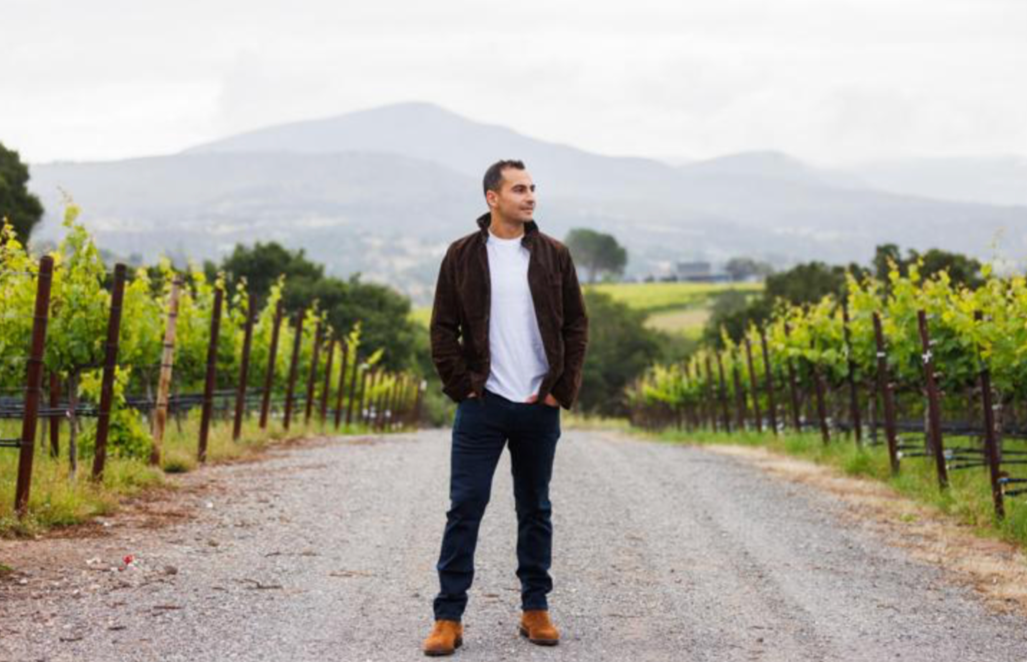
As the owner of the Napa-based winery located in the Atlas Peak subregion, the 39-year-old Amrani has overseen a growing brand, where he has already worked with more than 20 different grape varieties — nearly 18 or 19 in the latest vintage alone — a range that underscores how far he’s pushing beyond Napa’s standard Cabernet Sauvignon comfort zone.
“For us it’s really offering accessibility, and truly the number one purpose is to help people discover Napa beyond traditional varietals," he said.
A fit triathlete who he admits he operates on little sleep, Amrani seems to live by the grind-and-hustle mindset that was honed on the other side of the country. But his story begins even farther east.
Amrani was born in Casablanca, Morocco into a large extended family, where success was predicated on high academic achievement and entering the medical profession. As a teen, he worked hard but struggled to find a passion and a sense of direction. Growing up in Morocco, his limited exposure to wine consisted mostly of heady French varietals that his father, a pilot who frequently traveled to Europe, would have him try.
Yet neither wine, nor following in his father’s footsteps, would shape his initial formative years.
At age 17, he acquiesced to his father’s wishes and was sent to Senegal in West Africa to begin his studies in medicine. He found the experience sobering, and a bit traumatizing.
“I hated studying medicine," he recalled. "I didn’t really know what I wanted to do, but I knew medicine wasn’t it.”
With a hefty dose of youthful audacity and bravery, Amrani, then 18, managed to obtain a tourist visa to the U.S. With $150 in his pocket and a one-way airplane ticket, he landed in New York with little notice to his family, aside from a brief call to his father while he was in transit.
Amrani remembers that conversation with his father as difficult. He was given an ultimatum: Return to Morocco and all would be forgiven, or continue on his journey alone, with no familiar support financially or emotionally.
But Amrani wanted to prove his father wrong. “I didn't want to make that call to say ‘I failed,’ because I wanted to do this on my own,” he said.
His transition to New York, however, was fraught with instability. Homeless, and with his savings quickly depleted and little income, he slept in various subway stations for months, and took showers at a gym he had joined.
“My father had disowned me at that point,” he said.
In order to survive as a hardscrabble undocumented immigrant in New York City with limited funds and English proficiency, he found his first jobs by word of mouth, including a stint at a Subway sandwich shop where he labored for weeks without pay, and working in the back of a laundromat.
But his perseverance was beginning to pay off.
Starting at the bottom as a dishwasher at a fancy cocktail bar in Manhattan, Amrani quickly moved up to busboy, then bar back, before the bar manager “gave me a chance” and pulled him behind the bar as a bartender.
“I wouldn’t be here today if it wasn’t for him,” he said. “So many people have been there for me along the way, but he certainly was one of the first ones to help me out.”
Amrani sees that serendipitous promotion as the turning point that launched him into the world of hospitality and, eventually, offering his own wines. He met key industry people at Moët Hennessy Diageo — a global luxury goods and alcohol distributor — who later became his suppliers.
By age 21, Amrani had been offered a sales job with Moët Hennessy Diageo in New York. Eventually he started a wine import business, taking weekend business trips to Europe, where he would show up unannounced at various wineries, tasting their selections and purchasing quantities of the ones he liked.
His last restaurant job was as beverage director and manager at a French–Japanese restaurant in Manhattan. It was there that he met Torie Greenberg, his future wife and The Vice’s chief brand officer, who was bartending while in college at The New School's Parsons School of Design.
After his first visit to the Napa Valley in 2009, Amrani made several return trips, where he sought out wines that would both reflect the diversity of its terroirs and be affordable to a broad range of consumers.
While he was unable to find such a brand, Amrani saw the gap as an opportunity that would become central to The Vice’s mission and its business plan – “breaking down Napa Valley” both by variety and sub-appellation, which he says honors the region’s diversity and uniqueness, and making those distinctions visible and accessible to drinkers.
In Napa, a sub-American Viticultural Area is a smaller, federally recognized appellation within the broader Napa Valley AVA — places like Coombsville, Oakville, Mount Veeder or the Stags Leap District. Amrani argues these aren’t just map lines.
“You cannot compare Coombsville to Oakville or Mount Veeder to Atlas Peak,” he said.
In these "completely different” neighborhoods, changes in elevation, exposure, fog and soil make a Carneros Pinot Noir or a Coombsville Cab behave nothing like one from Atlas Peak.
The Vice’s portfolio is built to highlight those contrasts, using single-AVA bottlings to show how a few miles — or a shift from volcanic rock to Mount Veeder’s “island in the sky” slopes — can radically change what’s in the glass.
Orange wine
The Vice may now best be known for one of Premiere Napa Valley’s most talked-about lots — the first-ever orange wine sold in the event’s history. The 60-bottle lot sold for $9,720, or $162 a bottle, something that Amrani said nothing could have prepared him for.
“Not in my wildest dream did I think an orange wine would raise $162 per bottle,” he said.
But at The Vice, orange wine isn’t a fad — it’s a generational pivot, one that Amrani recognized during a pandemic-era visit back to where it all started for him in New York City. In the hip Brooklyn neighborhood of Williamsburg one evening, he met up with his longtime photographer and digital director — both based in the area — and found them drinking orange wine that wasn’t from The Vice, despite having access to his own samples.
Instead of seeing this as a slight, he started taking notes. As he walked retail shelves across Brooklyn, he noticed that orange wine wasn’t just a curiosity tucked between rosé and white; shops were dedicating full sections, or “orange corners,” stocked largely with imported bottles from Spain, Slovenia, Greece, Georgia and southern Italy.
“Everywhere I went, I saw orange wine,” he recalls.
Noting the demographics of those who embraced orange wine early on, Amrani reads the wine market through a generational lens, crediting Gen X with building Sauvignon Blanc and rosé while seeing orange wine as the next frontier for millennials and Gen Z.
This group is now in its peak earning and experimenting years, according to Amrani, who sees them as a major target for categories like orange wine, natural wine and nontraditional Napa styles.
“Last year, millennials were officially the largest consumer of wine, and they’re probably gonna hold that crown for the next 25 to 30 years,” he said.
Despite its name, orange wine, also called "skin-contact white wine," uses a fermentation process that leaves the grape skins on during maceration, which is the soaking of the skins, stems and seeds in the juice. This more hands-off approach results in higher tannins and a complex flavor profile that makes it a kind of bridge wine that solves pairing problems where both classic reds and whites struggle — especially with spiced, complex cuisines.
Now, the winery has evolved its once-experimental orange wines into a focused program that now includes five orange bottlings.
The 2025 vintage, “The Vice, Napa’s First Orange,” is crafted from 100% Viognier grown in Napa’s Oak Knoll District. It was skin-fermented for 26 days with native yeast and aged six months in a single 30-gallon French oak barrel. The Vice had previously released several other orange wines, including "The Brooklynites," made from Sémillon grapes; a "Pickleball," made from Viognier; “Sierra” from Carneros; and “Sevilla,” from Albariño — and a nod to both the Spanish-origin of the grape and “Sevilla” oranges, for those who think that orange wine is made from oranges.
“At The Vice we name our wines either after family members, staff, places, or the vices that drive us,” he said.
In spite of The Vice's accolades, Amrani characterizes the brand’s current stage as its “teenage years” — fast growth, a bit awkward, and not the time to chase every shiny object.
“2020, ’21, ’22 were so experimental, I even made a couple of mistakes,” he said. “Now we’re a little bit more precise.”
At The Vice, Amrani uses skin‑contact whites and off‑dry styles as an “entry to the wine category” for younger drinkers facing a wall of flavored vodkas, ready-to-drink beverages and hard seltzers. Even as his experimental orange program has already produced a second best‑selling inventory and the record-setting Premiere lot, he still keeps Cabernet — still more than 60% of production — as the brand’s core.
“We are not gonna pull back from Cabernet,” he said.
For Amrani, innovation isn’t a detour from Napa tradition; it’s how to keep Napa wines relevant without pricing people out. That means making his brand warm, inviting and affordable. And he’s betting that younger drinkers are ready to see, and experience, Napa differently.
In The Vice’s ample wine cellar – named The Bat Cave carved into a hillside on the property – the brand’s history is illustrated in a scrapbook-like style along the walls, and includes an early rejection letter from a prominent wine competition. His and Torie’s dog, Bruce Wayne, who Amrani boasts as The Vice’s chief sommelier and blessed with “300 million olfactory receptors in his nose,” is the brand’s unofficial ambassador.
Amrani wants people to understand that while his work with orange wine is putting him on the map as a wine innovator, he insists that it is “a return to one of humanity’s oldest wine traditions,” long before Cabernet ever found its way into the valley. He points back to Georgia and the Caucasus, where he explained that archeologists have found 8,000‑year‑old evidence of white grapes fermented on their skins in buried clay vessels — essentially the same amber, skin‑contact style he’s now reinterpreting in Napa.
And if that means pouring skin-contact whites alongside Cabernet, all the better.
The Vice Wine is located at 2275 Old Soda Springs Road in Napa. For more information, visit thevicewine.com.
